
OddWatt - ECC802S SRPP / EL84 (6BQ5) Push-Pull Tube Amp
Bruce Heran  
|
OddWatt - ECC802S SRPP / EL84 (6BQ5) Push-Pull Tube Amp
This project is a bit of a departure for me. I really didn't need another amplifier as I have lost count of how many are around the house, perhaps as many as 15 or 20. This project was an exercise in what would happen if I combined some interesting concepts. I first saw this type of output circuit on diyparadise which is variation of the Compact Hi-Fi Power Amplifier by Melvin Leibowitz. If mine looks a lot like those, it is because it is similar. So why did I call it Oddwatt? Well at first glance it looks like it shouldn't work or at best work poorly. To my surprise, it not only works, it works well!
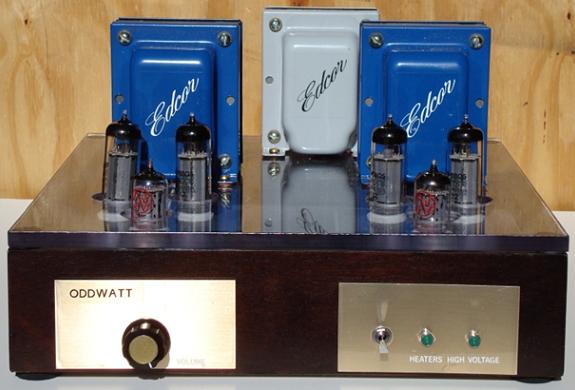
Photograph 1: ECC802S SRPP / EL84 Push-Pull Tube Amplifier
CCS Output Stage
The following is a simplified description of the output stage. Tubes conduct current in response to changes in the voltage between the grid and cathode. In order to establish a basic flow of current through a tube, a voltage is applied called bias. For power amplifier tubes cathode bias and fixed bias are the most common. Cathode bias is accomplished by raising the cathode voltage above ground and keeping the grid at approximately ground. For example, a tube requires -10V of bias to conduct 50mA, then the cathode can be raised to +10V with the grid at 0V. This is done with a resistor in the cathode circuit. Following Ohm's Law, 10 (volts) = 0.05 (amps) X R (ohms). So R is 200 ohms. In fixed bias circuits, the cathode is frequently at ground potential and the grid is negative. This is accomplished usually by feeding a negative voltage to the grid through a relatively high value resistor. Both cathode and fixed bias is used in high quality amps. In the Oddwatt, I use a constant current source (CCS) in the cathode circuit. A CCS regulates the current flow very closely. It allows the voltage to vary while keeping the current constant. With this in mind, here is how the Oddwatt works. With both cathodes essentially tied together, each sees the same cathode voltage. The CCS allows the cathode voltage to vary and maintains the current constant. So with the one grid at ground potential (through the 47 ohm resistor) and no signal on the other grid, both tubes will conduct an equal amount of current. If you apply a signal to the driven tube, the difference between the cathode voltage and grid will change. As a result the tube will either conduct more or less current following the signal voltage. If it conducts more the CCS will raise the voltage on the cathodes and thus increase the bias on the second tube. If the first tube has a negative signal and conducts less current, the CCS will reduce the cathode voltage and the second tube will conduct more. It is a sort of see-saw arrangement. The only name I could find for this type of circuit was "common cathode impedance, self balancing inverter" (CCISBI). It is an old design that I suspect fell into disfavor as quality performance requires a closely regulated current through the tubes. This would have been difficult and expensive in the early days of hi-fi. It will also only work for class A amps. It is possible to implement the circuit with a fixed cathode resistor, but the results are probably going to be unsatisfactory. Additionally, the cathodes can not be bypassed as it will upset the signal balance. There are however advantages. There is only one coupling capacitor. The drive requirements from the previous stage are half those of more common designs. There is at least one fewer tube section needed. The circuit according to the literature retains the low harmonic distortion levels of other more common push pull designs. I could not follow the math so I will have to accept it on faith. For more information about these voltage regulators, see my notes onThe Care and Feeding of LM317 and LR8 Integrated Circuit Regulators, Particularly in Valve Circuits.
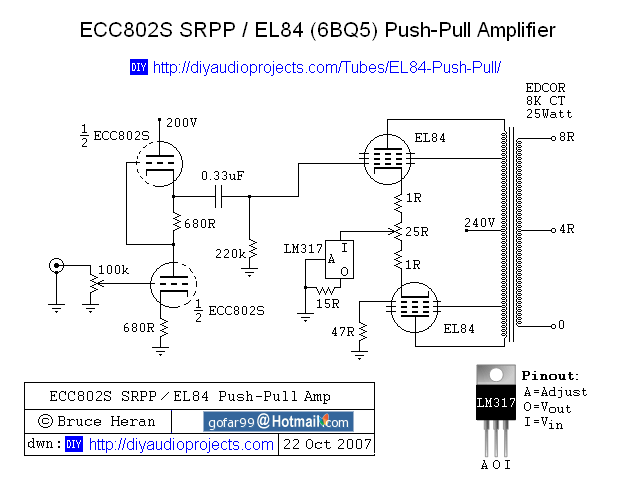
Figure 1: ECC802S SRPP / EL84 Push-Pull Tube Amplifier Schematic
EL84 Push-Pull Design Concepts
Since this amplifier project was an experiment, I wanted the design and not the components to influence the sound quality. Thus, quality parts are used throughout. EDCOR transformers, Ruby electrolytic capacitors, Auricap coupling capacitors, matched tubes ... I suspect that good results can also be achieved with less expensive parts. Another feature I wanted to try was an SRPP driver stage.
Tube Amp Features:
- DC heater supply by a 12 volt SMPS.
- Ultra linear operation of the output stage with Sovtek EL84 tubes.
- SRPP driver stage with ECC802S tubes.
- Provision for tube balancing.
- Constant current sources for the output stages using LM317 Voltage Regulators.
- Relay control of the B+.
- Minimum component count in the amplifier stages.
Tube Amp Heater Power Supply
The heaters are supplied with a regulated DC supply provided by an off the shelf switch mode power supply (SMPS). The SMPS is rated at 12VDC / 3A. The output is quite clean and even though I used tube heater snubbers, I probably could have omitted them. I did not see a significant amount of trash or noise on the 12VDC output. Each channel was wired for 6V heaters. The center point was returned to the main system ground. This made one set of heaters positive to the ground and one negative. I could not identify any adverse results of the arrangement. The SMPS also provides power to the indicator lamps and B+ switching relay.
Tube Amp High Voltage Power Supply
The B+ supply is rather straight forward. Two fast recovery rectifiers working off a center tapped 180-0-180V, 250mA EDCOR transformer. Filter capacitors are Ruby electrolytic bypassed by Solen polypropylene. An extra pair of electrolytic capacitors are used for the SRPP plate voltage connection. This arrangement cleaned up a small amount of ripple from the B+ supply. I tried series resistors (1k) in front of the filters and it didn't seem to make any difference, so I removed them. The B+ to the outputs measured 240V and 200V at the SRPP plates.
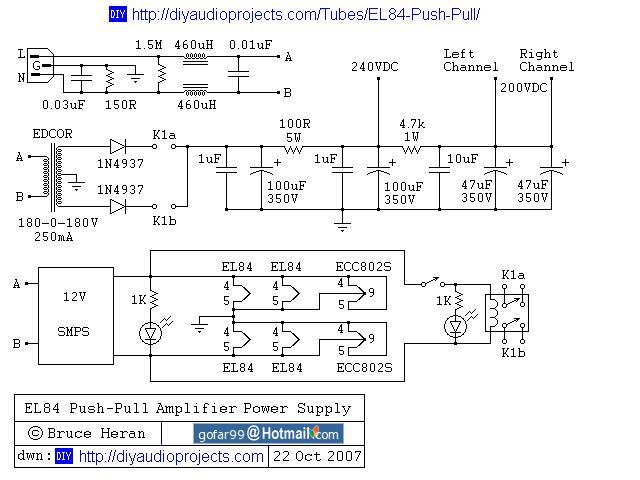
Figure 2: EL84 Push-Pull Tube Amplifier Power Supply Schematic
Tube Amplifier Construction - EL84 (6BQ5) Push-Pull
I wanted to ensure that the amp could be modified easily as it was "experimental" and I also wanted it to look good. I always try to build things with the thought that the end product is going to be on display. The enclosure is a wooden "shadow box" that came from a department store. The top is a thick piece of Plexiglas given to me by Barry who used Plexiglas for the enclosure of his K-502 Tube Amplifier Kit Project (thanks Barry). The circuitry is on three boards. Each amp channel is on a separate board. The boards are copper clad and the conductive surface is used like a ground plane. The power supply (less SMPS) is on a plain perforated board. All wiring is point to point. My original design was to use a printed circuit, but it quickly became clear that it would be difficult to modify. The bottom (to keep me from sticking my fingers on the B+) is an ornamental aluminum door screen cut to fit that came from the hardware store.
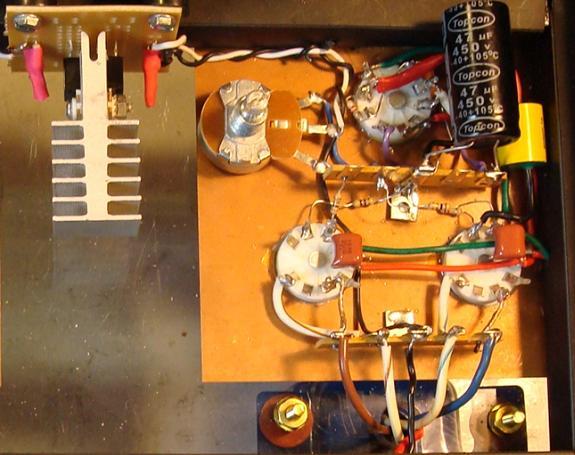
Photograph 2: EL84 PP Amplifier Circuitry on Copper Clad Boards
ECC802S SRPP Driver Stage
SRPP amplifier stages are noted for several positive, and a few not so positive features. The output tubes, because of the design need only half as much voltage drive as a conventional push pull pair (only one tube is driven). This makes it possible to use nearly any driver. A single ended one would be fine. But since I was "experimenting" I chose the SRPP. Biasing a SRPP can be tricky. It can be rather problematic to get symmetrical output from a SRPP. I adjusted the cathode resistors from about 400 ohms to 2000 ohms. I wanted the tubes to operate in a linear region. At first I tried a 12AX7, then 12AT7, followed by 12AU7 but finally settled with ECC802S which are quite similar to a 12AU7. The ECC802S provided the best combination of gain and linearity. The bias is set at about 5mA. The center point between the cathode of the upper section and plate of the lower one is almost exactly at one half of the power supply. Voltage swing available was over 20V peak to peak. Only 8V is required to deliver full output. All signal and power grounds are returned to a central ground point in the power supply.
EL84 (6BQ5) Push-Pull Output Stage
The push-pull output stage is quite similar to that shown on diyparadise and refers back to earlier circuits. I take no credit for the original design and only altered it to suit my needs. There is a lot of information regarding this circuit type on the web as to why it shouldn't work, and if it did it would be horrible. I can't verify what others did, or did not do, but mine works very well (see listening and measurement tests).
Measurements - ECC802S SRPP / EL84 (6BQ5) Push-Pull Tube Amp
This EL84 push-pull amplifier measured quite well. All measurements were made at the 8 ohm tap with 2.5V output. Low frequency response with sine waves was flat to 18 Hz and -3 dB at 8 Hz (the low end of my signal generator). High frequency response was flat to 25 kHz and -3db at 35kHz. The response was only down -12dB at 100kHz. There was usable output (clean) at 140kHz which is the upper limit of my signal generator. Square wave response was excellent. Mid band shapes were nearly perfect. 20kHz square waves were about as expected for a tube / transformer combination. That is to say, quite good with minimal ripples and sloping on leading and trailing edges. This is largely due to the transformers. In this area, I elected for transformers with lots of iron and reserve capability (25W). This almost certainly entailed an increase in capacitance and inductance that would alter the shape of the square wave at higher frequencies. The slope of square waves at low frequencies indicated a slight low frequency boost. I was unable to see such a boost in the sine wave traces though. The output had virtually no hum or noise. Both were below 1mV which is the limit of the B&K 1479B Oscilloscope. Power output was approximately 10W per channel and was well behaved when overdriven.
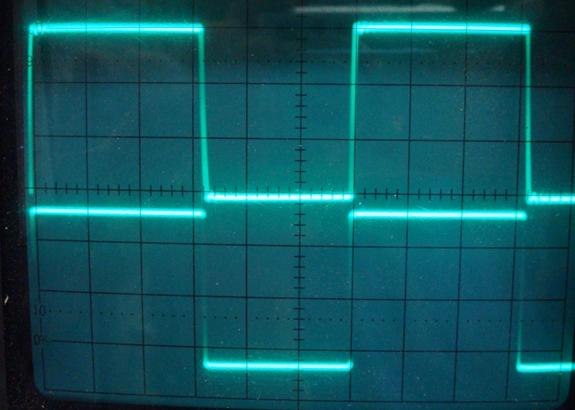
Photograph 3: 1000 Hz Square Wave (Top Trace is the Output)
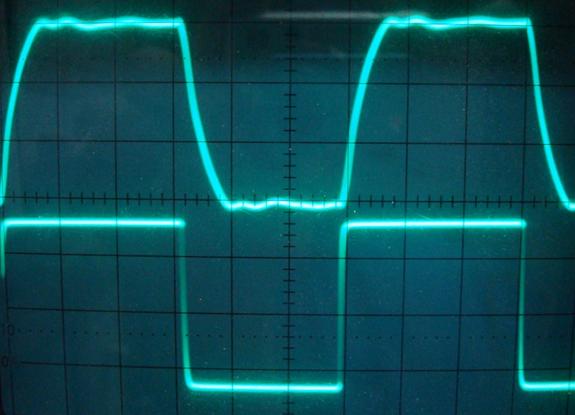
Photograph 4: 20 kHz Square Wave (Top Trace is the Output)
Distortion measurements were made using an HP 331A Distortion Analyzer, a Tenma Low Distortion Signal Generator (0.05% residual THD) and a B&K 1479B Oscilloscope.
Table 1: Distortion Performance of Oddwatt 212
| Frequency (Hz) |
Power (W) |
Distortion (%) |
Distortion (%) (Triode mode) |
| 20 100 1000 10000 |
1 1 1 1 |
0.66 0.65 0.60 0.60 |
0.35 0.35 |
| 100 1000 |
4 4 |
1.7 1.7 |
|
| 1000 | 5.1 | 3.8 | |
| 20 100 1000 10000 |
10 10 10 10 |
0.68 0.66 0.68 0.66 |
|
| 1000 | 12.5 | 1.4 | |
| 1000 | 15 | 2.3 | |
| 1000 | 18 | 3.1 |
Listening - ECC802S SRPP / EL84 (6BQ5) Push-Pull Tube Amp
So how does it sound? The short answer is excellent. Midrange detail is as good as anything else I own. Upper range detail is better than all my other amps. Bass is clean but not excessive. It has the characteristic tube warmth and is easy to listen to. With generic 12AU7A tubes as drivers it was a little more lively, but the JJ ECC802S tubes had a very nicely balanced sound. How does it compare to some other equipment I own? It is more detailed and has more "muscle" than my modified K-12 tube amp kit This is most evident in the top end detail and bottom end strength. Midrange is rather similar between the two, but the sound stage seems a bit wider with the Oddwatt. When compared to my LM3875 Chip Amplifier kit, it has a smoother sound and better detail on the upper mid range. As expected it lacks the solid impact and power of the chip amp. If I lived on a steady diet of rock music the chip amp is superior. Since I prefer more delicate music, like string guitars, harps, pianos and solo vocalists, the Oddwatt sounds more musical to me.
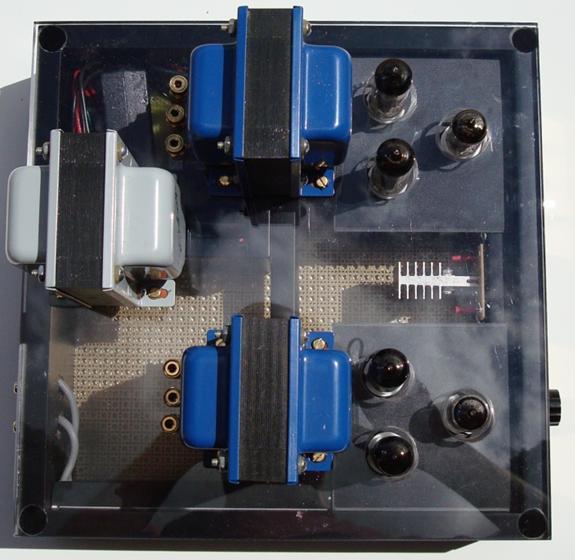
Photograph 5: ECC802S SRPP / EL84 Push-Pull Tube Amp (Top View)
Additional Thoughts
This amp is not for everyone. For one, it is heavy at nearly 15kg. Tube purists need not build this one as there are several solid state components. It was also not a cheap project. It wasn't intended to be one as it was more of a learning experience regarding circuits that I wanted to try. The transformers alone were around $160US, the matched quartet of Sovtek EL84 and matched JJ ECC802S added another $70. Auricap, Ruby and Solens capacitors all added more. I didn't keep close track of the total costs, but I would estimate that it was between $350 and $400. It is possible to build a simpler version for a lot less (perhaps under $200) with inexpensive components, but that wasn't my intent. I hope I sparked some interest in you trying new projects. I enjoyed building this amp, but it is still a work in progress having recently been provided some new ideas for it from other diyers. It even has a good WAF. She likes the way it looks and sounds.
Good listening, Bruce
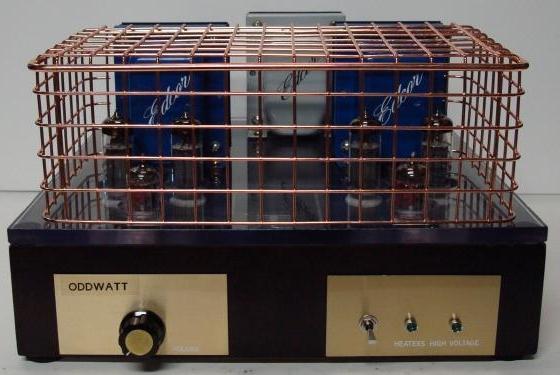
Photograph 6 - EL84 Push-Pull Tube Amplifier
UPDATE - 15 December 2007
Since the amp was finished I found the need to make a change in the heater circuit. This change is important and is a must fix. I overlooked an important specification during the design and construction of the amp. It is one that almost never is a consideration. It is the maximum heater to cathode voltage on the tubes. The maximum rating for an ECC802S is 100 volts. Because I was using a SRPP stage, one cathode is going to be significantly above ground. Since the B+ supply for the drivers at no load (before the tubes warm up) is around 200 volts, it is possible depending on how fast and which section of each driver tube warms up first to greatly exceed the 100 volt cathode to heater limit. After they are warmed up the level is within limits at around 90 volts for the upper section and essentially at zero for the lower one. The way I found out about the problem was the failure of one of the preamp tubes. It is an easy fix. Just disconnect the ground wire from the SMPS and attach a 100k resistor from the B+ to the former SMPS ground terminal and a second 47k resistor to the ground from that junction. It forms a simple voltage divider with about 1/3 of the main B+ (about 250V) applied to the junction. There is no current flow as there is no return path. It does though establish a reference point for the heater circuit which is high enough to protect the upper triode of the SRPP and not too high for the lower one.
UPDATE - 19 October 2009
Bruce has updated and improved this EL84 OddWatt amplifier. The tube amplifier project uses EL84 / 6BQ5 valves in a self-inverting push-pull topology with a 5751 SRPP driver stage. For full details see the PoddWatt class-A stereo EL84 (6BQ5) tube amplifier project page.
UPDATE - 30 September 2012
Bruce has updated the OddWatt self-inverting push-pull EL84 amplifiers once again. The latest version is constructed as mono blocks and again uses a 5751 SRPP driver stage. The mono block amplifers deliver more power and improved performance. For full details see the Mini Block ultra-linear class-A push-pull EL84 valve amplifier project page.
UPDATE - 9 October 2012
This was one of my first attempts to design and build a valve project. It actually came out quite well. Since then there have been many additional projects and two of them could easily be considered updates or evolutions of the original amplifier. The two newer projects are the Poddwatt Stereo amplifier and the Mini Mono Blocks. Both share more than a slight resemblance to the first project. While the original design is sound and easily built, I strongly recommend the Poddwatt for a stereo replacement of it and the Mini Mono Blocks if you need either a single monaural amplifier or if two separate mono blocks suit your needs better. There are also some updates to the Poddwatt that appear at the end of that project as well. Generally the changes involve custom designed output and power transformers (from Edcor EMO750 and EMO 719 which are now available on an individual basis), improved power supply, changes that improve linearity and slight increases in output power. The Mini Mono Blocks incorporate all the changes. Schematics are attached for both the newest Poddwatt and the Mini Mono Blocks.
The latest information about the various OddWatt Audio SIPP tube amplifier projects is available on the Oddwatt Push-Pull Tube Amplifiers thread in the DIY Audio Projects Forum. Please use the thread to ask your questions and to share your comments about this project.